
Beyond Tiki-Taka 1: Why Spain Has Now Become the New Standard for World Football
Wednesday, 22 July 2026 | 13:21
Author: Rojes Saragih

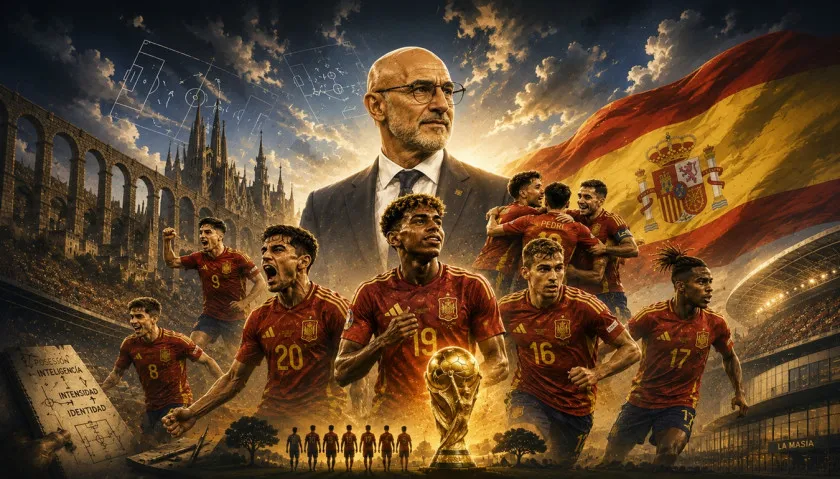
The 2026 World Cup may not just produce a new champion. This tournament could mark the starting point where the world rediscovers a new direction for football.
106th minute of the 2026 World Cup final.
At MetLife Stadium, New Jersey, Argentina still clung to hope that Lionel Messi could deliver one final moment of magic.
READ ALSO
Lineup of Global Celebrities Will Enliven the 2026 World Cup Final
Spain Becomes France's Nightmare, La Furia Roja Advances to the 2026 World Cup Final
Following claims that the 48-team format has been successful, FIFA is considering including 64 contestants for the 2030 World Cup tournament.
On the opposite touchline, Luis de la Fuente stood calmly in front of Spain's substitute bench. He was not searching for a saviour. He was simply calling upon another component of the system he had built over many years.
Moments later, Ferran Torres met Nico Williams' delivery to score the only goal of the match, ending Argentina's resistance. Spain won 1-0 and reclaimed the world championship title.
Most people will remember Ferran Torres as the match winner. Some will look back on this as Lionel Messi's final World Cup appearance. Yet there is every chance history will recall this match for a far greater reason.
This goal may not have only decided who would be crowned world champion.
This goal may have marked the birth of an entirely new chapter in the evolution of football.
Throughout history, there has always been one nation that sets the global benchmark. Brazil taught the world that football can be played with creativity and courage. The Netherlands redefined how the game understands space through Total Football.
Italy demonstrated that structured organisation can overcome raw individual talent, while Germany proved that systematic youth development reform can turn failure into glory.
And then came Spain.
They once dominated global football with tiki-taka between 2008 and 2012. The world copied their passing patterns, build-up play, even their approach to youth player education. But like every revolution in football, that dominance gradually lost its element of surprise.
The game became faster, more physical, more direct. Many assumed Spain's era at the top was over.
As it turned out, it was not Spain that had ended.
Only their old version had run its course.
The team that lifted the 2026 World Cup trophy did not merely revive past glory. They unveiled a new evolution of Spanish football identity.
Ball retention remained the foundation, but it was no longer treated as an end goal. Their play became more vertical, more flexible, and far more aggressive when out of possession. They no longer chased possession statistics - they chased control of the match.
This change was not built overnight.
It was forged through a philosophy preserved across generations, consistent youth development structures, and the courage to keep evolving without abandoning their core identity.
When greats such as Xavi Hernández, Andrés Iniesta, Sergio Busquets and David Villa retired from international football, Spain did not lose its identity.
Instead they produced Rodri, Pedri, Lamine Yamal, Nico Williams, Pau Cubarsí, Gavi and an entire new generation that speaks the same 'football language', but with a different accent.
Will the 2026 World Cup be remembered as the tournament where the world rediscovered the new future path of football?
To answer that, we must look far beyond the final scoreline.
We need to examine how a nation builds its identity, how tactical data and analysis only reinforce the narrative unfolding on the pitch, and why an increasing number of international coaches, analysts and media are now looking at Spain not just as world champions, but as the most relevant football model for the future.
How Did Spain Never Lose Its Identity?
Modern football changes at breakneck speed. Coaches come and go. Player generations rise and fall. A team that dominates today can lose its way entirely within just a few years.
Spain should have suffered that same fate.
They lost Xavi Hernandez, Andres Iniesta, Sergio Busquets, Gerard Piqué, David Villa and Sergio Ramos - players who defined Spanish football for over a decade. In most nations, the end of such a Golden Generation is followed by a long period of decline.
Yet the exact opposite happened.
Spain did not abandon their style of play. They simply replaced the people executing it.
Rodri stepped into the role once held by Busquets. Pedri brings the same footballing intelligence that defined Iniesta, but with a naturally more vertical playing style.
Lamine Yamal and Nico Williams provide far more explosive threat out wide than any previous generation of Spanish wingers.
Pau Cubarsí has become the face of this new generation of defenders: comfortable on the ball, and unafraid to operate far up the pitch from the defensive line.
These are different names.
But their football language remains identical.
That is the core of Spain's uniqueness.
They do not build a national team around the best individual players available at any given time. They build an identity, then pass that identity down to every subsequent generation.
This is why even changes of head coach have never fundamentally altered the team's character.
Vicente del Bosque took Spain to the pinnacle of World Football with tiki-taka. Luis Enrique added intensity and aggressive high pressing. When Luis de la Fuente took charge, he did not tear down that foundation. He only refined it to meet the demands of modern football.
This approach grew out of a philosophy long guarded by the Royal Spanish Football Federation (RFEF).
Over the last two decades, Youth Player Development, coach education, and playing philosophy across every age group national team have all been aligned to one single goal: to produce players who can read space, make fast decisions, and operate as one part of a collective system.
This is why Spain's success can never be attributed solely to La Masia, FC Barcelona's youth academy.
Barcelona's academy has produced many exceptional players, but Spanish football identity was also built by academies at Athletic Bilbao, Villarreal, Real Sociedad, Valencia and Real Madrid.
Each has its own distinct character, but they all converge on one core principle: a player must learn to think before they touch the ball.
Luis de la Fuente understands this ecosystem better than anyone. Before taking the senior national team job, he spent many years coaching Spain's youth national age groups.
He knew most of his squad from their teenage years, understood their personalities, and had already instilled this shared playing philosophy long before they stepped foot on a World Cup pitch.
This is why the transition ran so seamlessly.
When one generation retires, the next does not have to start from zero. They simply continue a story that was already written long before them.
The biggest shift instead came in how Spain translates this core philosophy onto the pitch.
While the 2010 World Cup winning side used ball possession as an end in itself, a symbol of dominance, the 2026 Spain team uses possession as a tool to create positional advantage and accelerate attacking moves.
They are far more willing to play vertical passes, far more aggressive with immediate pressing after losing the ball, and far more flexible with inter-line rotations.
Tiki-taka was not abandoned.
It evolved.
And perhaps that is the single greatest lesson Spain has given the world of football.
They never fell in love with one single style of play.
They only remained loyal to one principle: keep evolving, without ever losing who you are.
In modern football, that is the exact quality that allows a nation to remain relevant, even once every last member of their golden generation has moved on.







Belum ada komentar. Jadilah yang pertama!