
Robots in the Sports Arena: Just a Performance, or the Start of a New Era?

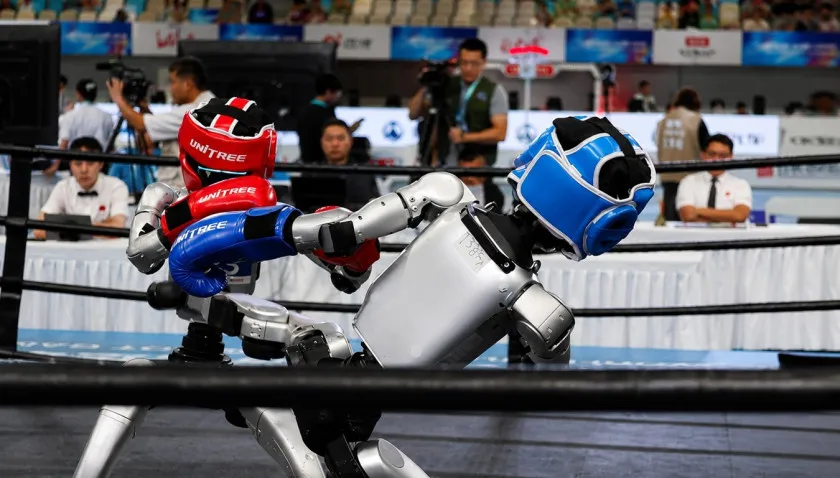
Beijing - A humanoid robot lands a high kick inside the ring. Its opponent loses balance and falls onto the mat, while the attacking robot remains standing before the match resumes.
Blows and kicks are exchanged back and forth. Loud impacts occasionally ring out as the machine bodies clash against one another, creating a scene that at first glance looks straight out of a science fiction film.
Yet this fight is taking place in a real, official sports arena.
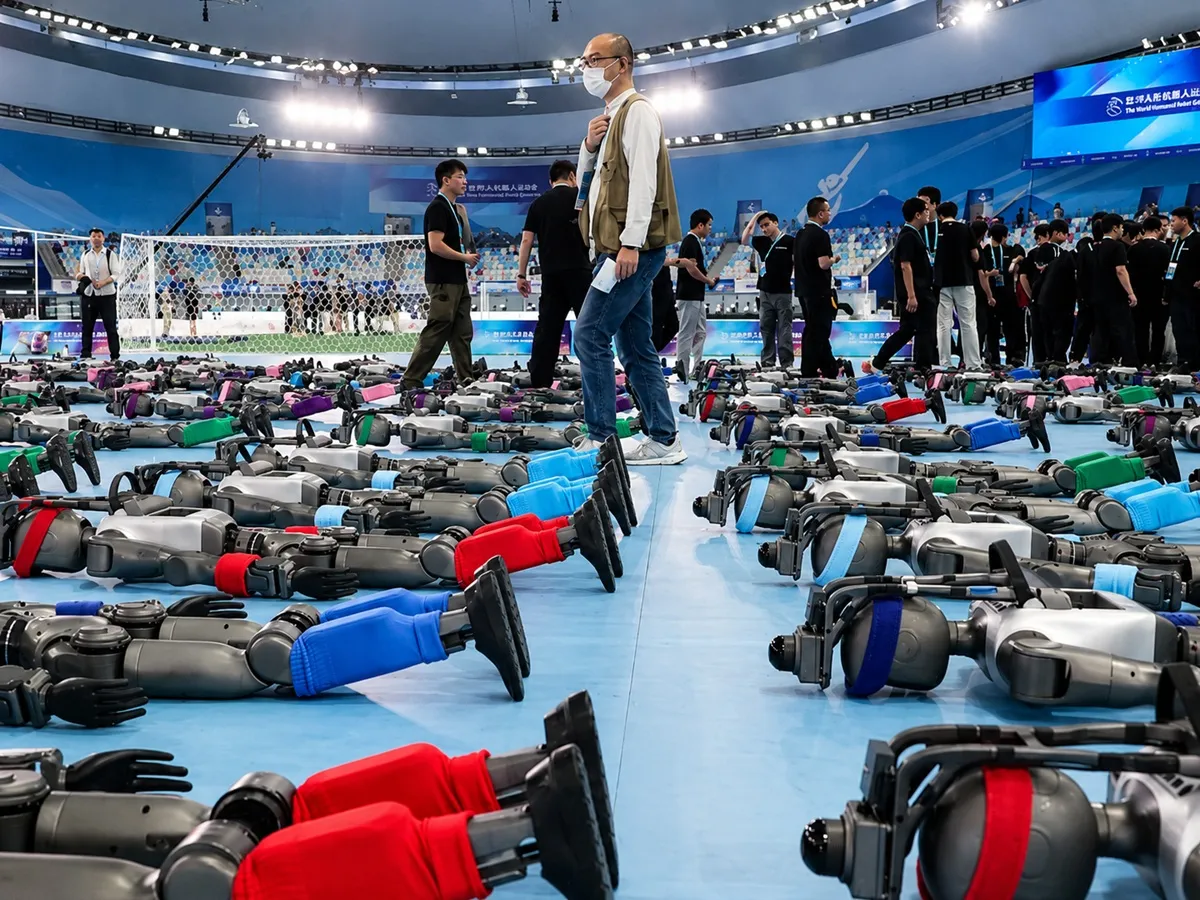
This footage is part of the 2026 World Humanoid Robot Games (WHRG), the humanoid robot sports competition held 22–26 August 2026 at the National Speed Skating Oval, also known as the Ice Ribbon, in Beijing, China.
This second edition of the event brought together 2,056 robots from 666 teams representing 16 countries, with 51 competition categories and 1,301 total matches held.
The robots competed across a wide range of disciplines, including athletics, football, kickboxing, gymnastics, weightlifting, as well as competition events based on real-world workplace scenarios.
In another arena for example, humanoid robots competed in 5-a-side football matches. They chased the ball, positioned themselves, took shots and attempted to coordinate with their teammates.
This is where the challenges become far more complex. It is not enough for robots to simply have moving legs. They must interpret what they perceive, decide on an action, then translate that decision into physical movement.
Indonesian participant Maharaj Faawwaz A Yusran experienced this challenge first hand when he joined the Malaysian team competing in the large robot category 5-a-side football event.
His team used Booster T2 model robots, and programmed the units to operate fully autonomously throughout matches.
"So the challenge is getting the robot to locate the ball, then kick quickly and accurately, and also figuring out how these robots can communicate with one another," Faawwaz stated, as quoted by Antara on 30 August 2026.
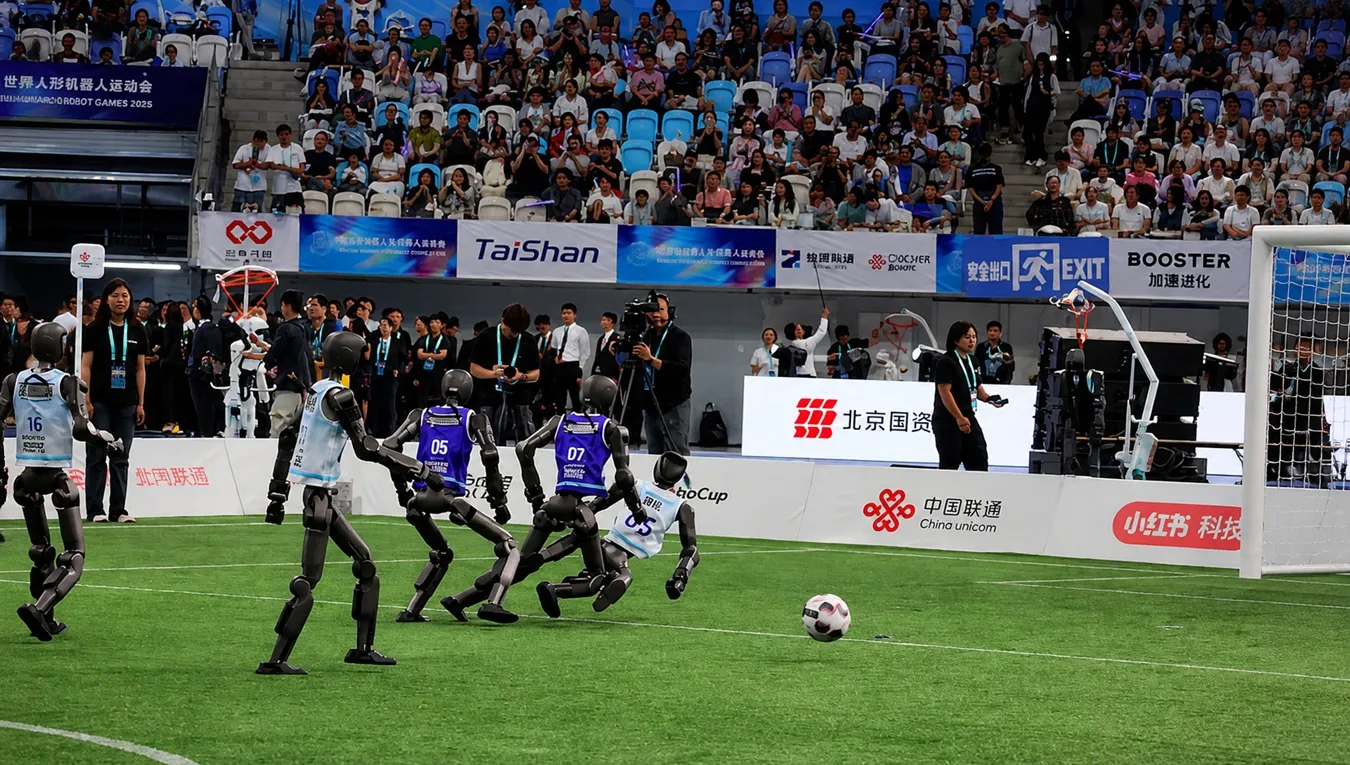
Source: Antara/Desca Lidya Natalia
From kickboxing rings to football pitches, the 2026 WHRG demonstrates that this competition is far more than just a showcase of robots mimicking human movements.
What is actually being tested here is how well robots can use their physical bodies to respond to constantly changing situations.
When Robots Chase Human Speed
The single most watched event throughout the competition was the 100 metre sprint.
In the large robot category final, one robot recorded a finish time of 8.64 seconds — faster than Usain Bolt's human 100m world record of 9.58 seconds.
This result also set a new competition record for humanoid robots, following earlier times of 9.39 seconds and 8.86 seconds recorded in earlier rounds of the same event.
However, these robots do not run using the same biological mechanics as humans.
Usain Bolt achieved his record speed through the combination of muscle, tendon, starting technique, stride length and stride cadence. Robots rely instead on electric motors, actuators, sensors and control software to produce their movement.
Reuters analysis noted that the robot which ran 8.64 seconds took over 50 steps to cover 100 metres, while Bolt required approximately 41 steps when he set his world record. The robot also started from a standing position, not from starting blocks.
These differences make this achievement far more interesting than a simple comparison of who is faster.
Robots are not becoming faster versions of humans. They are developing their own entirely distinct methods of movement.
Even so, the limitations of current technology became obvious immediately after the finish line. Multiple robots lost their balance and crashed into the safety matting, while one unit began emitting sparks forcing event staff to attend with fire extinguishers.
Speed, it turns out, does not automatically equal control.
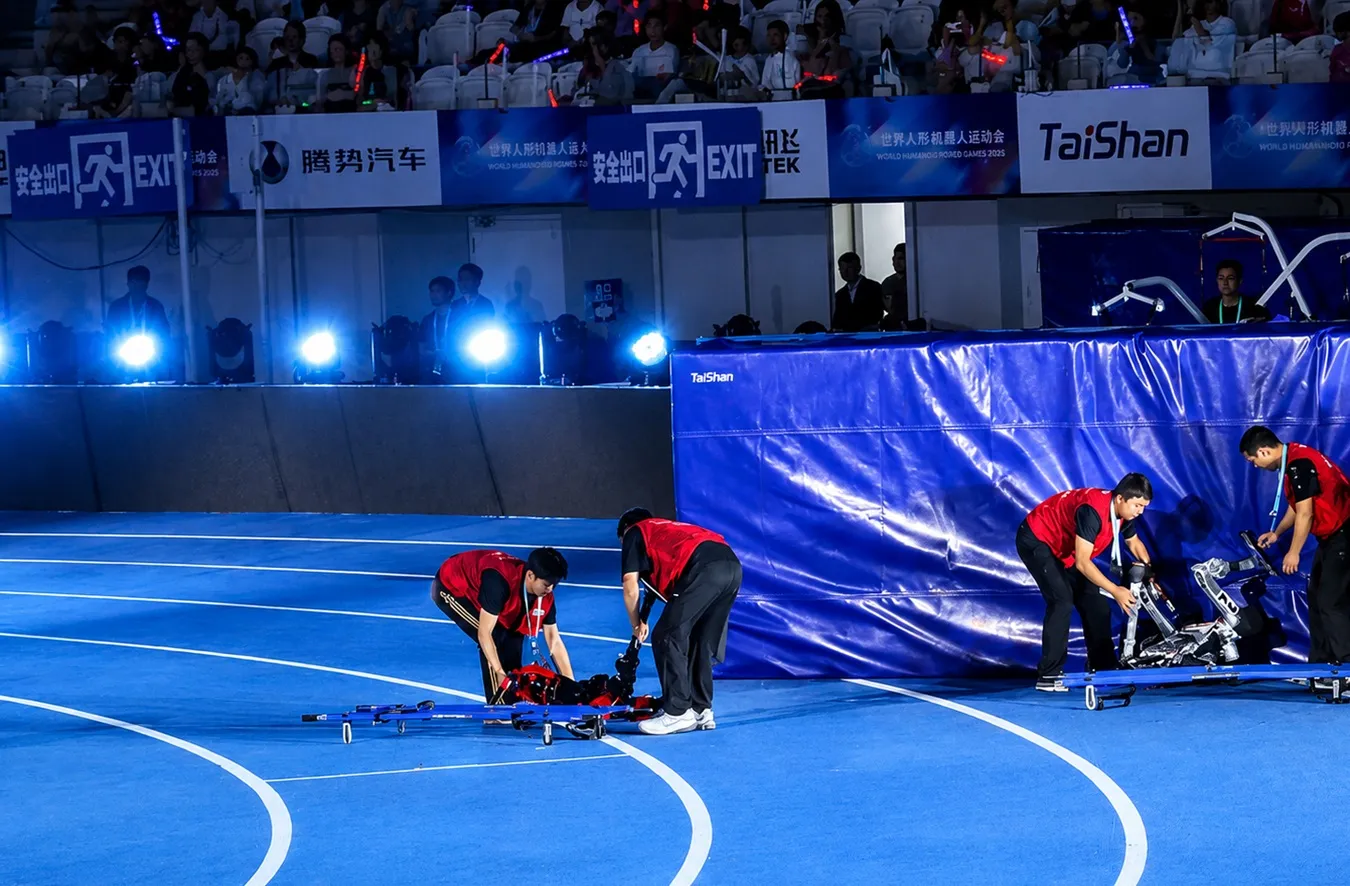
Source: Antara/Desca Lidya Natalia
From Sprints To Complex Team Games
The 100 metre sprint presents robots with a relatively controlled environment. Direction and distance are fixed, and the core task is simply to generate maximum speed while remaining upright.
Football is exponentially more complicated.
The ball moves freely, opponents constantly reposition, and teammates make their own independent decisions. For 2026 WHRG, the football competition was upgraded from 3-a-side at the previous edition to full 5-a-side, drastically increasing the requirements for visual perception, spatial awareness and inter-robot coordination.
A robot must judge whether chasing the ball is the correct choice, whether to pass, shoot or reposition. It must also continuously track the location of every other robot on the pitch around it.
For humans, these decisions happen near instantly, often without conscious calculation. For robots, this entire process must be translated into systems that can perceive the environment, process input data, select an action, then physically execute that movement.
This is one of the core reasons humanoid robots are still largely developed as specialised machines today. A robot built for exceptional sprinting performance will not necessarily be good at football, and a robot that excels at one single movement may be unable to complete other more complex tasks.
Bodies That Must Learn
These challenges are directly tied to the field of embodied intelligence: the ability of artificial intelligence to understand its environment through its physical body, make decisions, and translate those decisions into action.
Humans perform this entire process almost without thinking. We see a ball, predict its trajectory, choose an action and move our body all within fractions of a second.
Robots must learn every single step of this sequence through the combined operation of sensors, hardware and software.
The next great challenge is making this ability function reliably when conditions change. The ball will not always come from the same direction, opponents will not always take the same positions, and match conditions will never perfectly replicate training environments.
For this reason, adaptive capability has become one of the most important metrics for humanoid robot development.
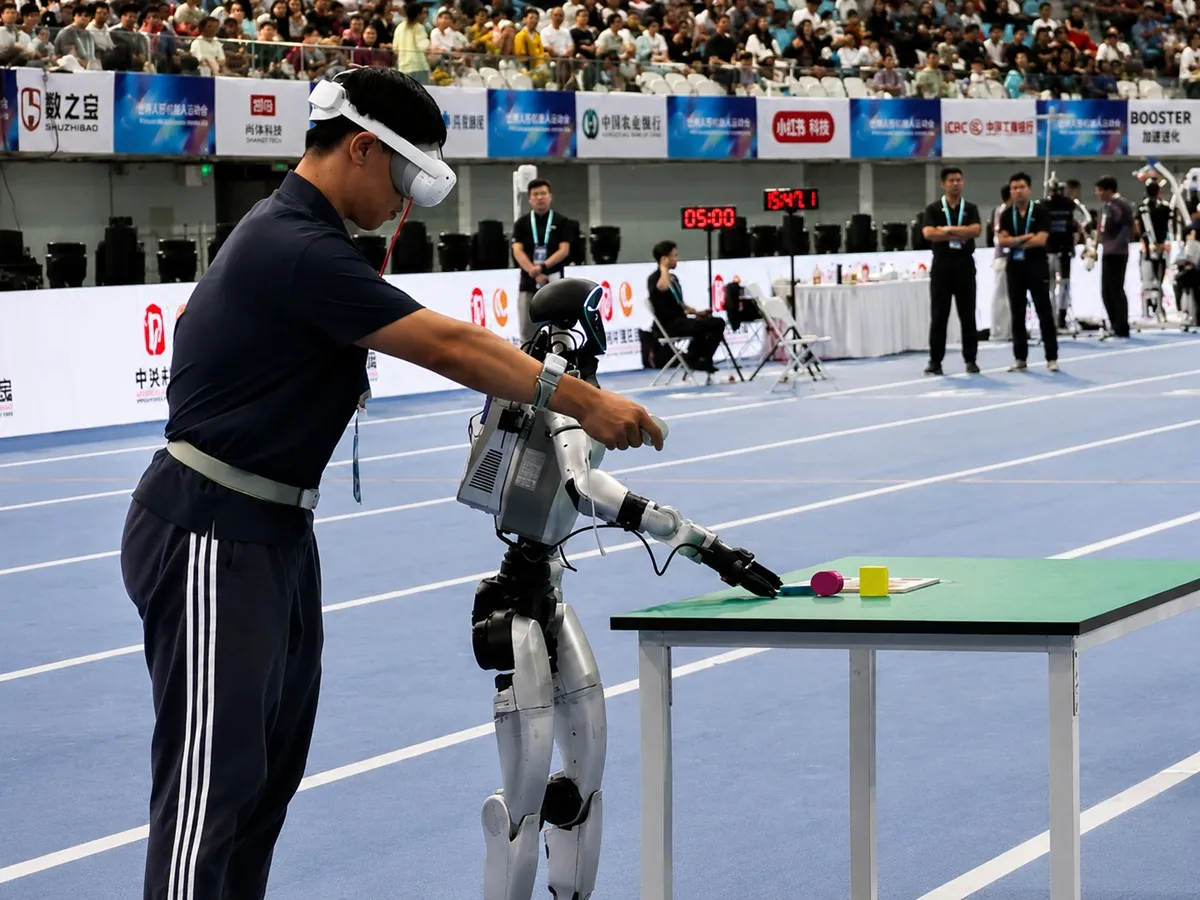
Source: Antara/Desca Lidya Natalia
The Arena As An Open Laboratory
The 2026 WHRG does not only test robots as athletes. This competition also includes 21 real-world scenario events spanning nine sectors, including domestic home work, hospitality, manufacturing, emergency rescue, logistics, library operations, retail and office administration.
Robots are scored on their ability to complete assigned tasks fully autonomously. This means matches are no longer just testing if a robot can perform a single movement — they test if a robot can successfully complete work when operating in unstructured, complex environments.
This is how the sports arena has transformed into a form of open public laboratory.
Robots must operate under time limits, handle unexpected disruptions, make independent decisions, and display their failures publicly for all to see. Every mistake reveals the current limits of the technology, while every success points towards capabilities that can be developed further.
Source: Antara/Desca Lidya Natalia
Just A Spectacle, Or The Start Of A New Era?
It is likely still too early to declare the WHRG the beginning of a new era in sport.
Humanoid robots still face very significant limitations. They can produce extraordinary performance for specific isolated tasks, but cannot yet combine different capabilities with the same natural flexibility that humans possess.
However, it is equally impossible to dismiss this competition as nothing more than a novelty show.
For well over one hundred years, sport has been the way humans measure the limits of their own bodies: how fast we can run, how high we can jump, how much weight we can lift.
Now machines have entered that same arena.
The difference is that robots do not have human biological limits. Instead they face other constraints: battery life, motor performance, sensors, software, balance and decision making capability — all of which will continue to advance as technology develops.
For this reason, that 8.64 second sprint time is not actually the most important part of this story. That record will be broken again, sooner or later.
What is far more significant is the process behind it: robots are learning to use their bodies, interpret their surroundings, and compete with increasing independence.
For now, we can still call this a spectacle.
But if machines continue to learn how to move, compete and adapt, these sports arenas may become the birthplace of an entirely new form of competition, unlike anything we have ever known before.










Belum ada komentar. Jadilah yang pertama!