
Shin Tae-yong Builds, Herdman Chooses: A New Chapter for Indonesian Football

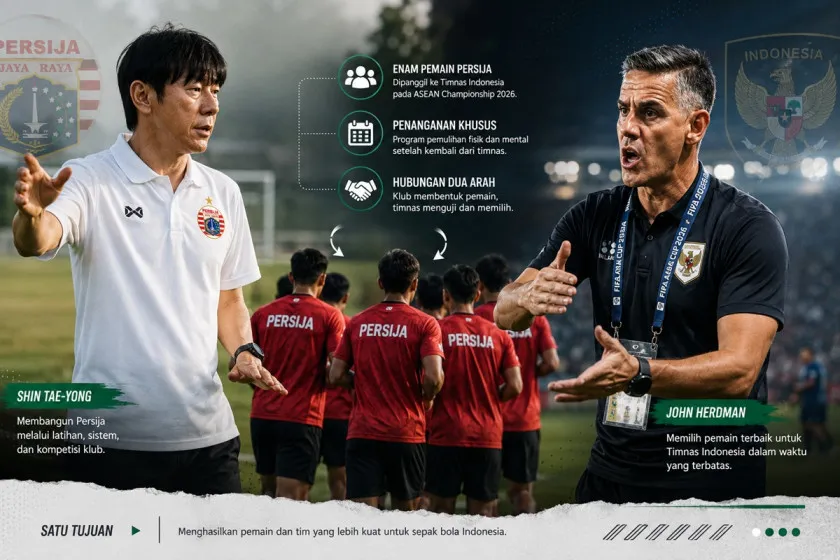
Jakarta - Indonesian football has entered a compelling new dynamic. Shin Tae-yong has taken up a club coaching role with Persija Jakarta, while John Herdman remains in charge of the Indonesian National Team.
The two no longer operate within the same structure as they did when Shin was national team head coach. Even so, their work remains deeply interconnected through Persija players that fall under Herdman's scouting radar.
This context makes the relationship between Shin and Herdman far more nuanced than if it were framed purely as a rivalry between two coaches.
READ ALSO
FIFA ASEAN Cup 2026: It's Time for John Herdman to Lead the Indonesian National Football Team to Claim the Championship Title.
From the setback at the ASEAN Hyundai Cup to the 2026 FIFA ASEAN Cup: This is John Herdman's real test.
Indonesia Fails to Advance to the 2026 AFF Cup Semi-Finals, Shin Tae-yong's Tenure is Once Again Drawn Into Public Comparisons.
Shin develops players through club training regimes and competitive matches. Herdman in turn selects talent from across all domestic clubs to assemble the Indonesian national squad. Work Shin carries out at Persija has the potential to directly influence Herdman's selection calls, while national team requirements will also shape how Shin prepares his club squad.
Put simply: Shin builds, Herdman selects.
Six Players As The Common Ground
This working relationship already has concrete, observable proof.
For the 2026 ASEAN Championship, Herdman called up six Persija players to the Indonesian national squad: Nadeo Argawinata, Jordi Amat, Rizky Ridho, Shayne Pattynama, Dony Tri Pamungkas and Rayhan Hannan. All six were named among Herdman's final 26-man roster.
Shin has already felt the direct impact of this overlap.
When Persija contested their 2026 President's Cup pre-season matches, all six players were still on national team duty, leaving the club unable to field their full strength side. Persija officials confirmed the players remained committed to national team commitments just as the club entered its new era under Shin.
Now returned from international duty, these six players require specialised handling.
Shin has designed individualised training programs to restore both their physical condition and mental sharpness following the national team's match schedule.
This seemingly routine situation is an early example of an issue that will become increasingly common.
Herdman needs Persija players for national team fixtures. Shin needs those exact same players to build his Persija project.
Shin Has Time, Herdman Does Not
The fundamental difference in the two men's roles is critical here.
As a club head coach, Shin has the entire league season to implement and refine Persija's playing structure. He can repeat training patterns, address individual player weaknesses, assign playing positions, and build on-pitch understanding between his squad.
Shin has already outlined the playing identity he intends to instill: he wants Persija to play high-mobility football modelled on total football principles, with players granted freedom to rotate positions and cover space for one another.
"I want Persija to be a side that plays with high mobility," Shin stated.
Herdman operates under entirely different constraints.
A national team coach must select players drawn from dozens of separate clubs, then integrate them into a cohesive unit in the very limited preparation window before international fixtures.
For this reason, players that develop well under Shin will not automatically receive a national team call up. They will still need to prove their abilities align with the specific requirements of the national team setup.
This is precisely what makes Persija such an important development laboratory for Indonesian footballers.
Herdman Was Already Monitoring Persija
Notably, Herdman's working relationship with Persija actually began before Shin returned to take charge of the club.
In January 2026, Herdman attended Persija training sessions in person. At the time he framed the club visit as part of broader efforts to build stronger working ties between the national team setup and domestic clubs.
Herdman noted that Persija's openness was invaluable, as he is working to establish trust and open communication with all Indonesian clubs. He also confirmed that attending club training sends a clear message to players that they are being consistently observed for national team consideration.
The dynamic has only become more interesting now that Shin is the coach tasked with developing these same players.
This has created a unique symbiosis.
Herdman selects players to meet national team objectives. Shin develops players to meet Persija's objectives. Yet the quality of player produced at Persija will ultimately feed back as an asset for the Indonesian national team.
FIFA ASEAN Cup As The Next Test
This alignment between club and national team interests will become even more significant in the lead up to the 2026 FIFA ASEAN Cup.
The tournament is scheduled for September to October during the official FIFA international match window. Indonesia will host the competition, though the opponent line-up was adjusted after India withdrew to prioritise an international friendly against Brazil. Bangladesh has accepted an invitation to replace India, with formal administrative confirmation still pending.
This change does not alter Herdman's core priority: he must still select the strongest possible squad available for this FIFA calendar tournament.
For Persija, the core challenge remains managing players returning from international duty and reintegrating them smoothly back into club schedules.
The 2026/2027 Super League itself is scheduled to kick off on 4 September. This tight overlap between domestic league fixtures and national team commitments makes physical fitness management and clear inter-party communication absolutely critical.
This Is Not Shin Versus Herdman
Public discussion will almost certainly continue to draw comparisons between Shin Tae-yong and John Herdman.
Shin left behind a notable record during his tenure as Indonesia national team coach, and has now returned to take on a very different project at Persija. Herdman was brought in to lead a new era for the Indonesian national team.
Yet framing this purely as a comparison of final results entirely misses the working relationship now developing between the two men.
Shin has time to mould and develop his players.
Herdman only has limited windows to test those same players at international level.
Shin builds consistent playing habits at club level.
Herdman evaluates whether those habits can translate successfully to international football.
If Shin succeeds in raising the standard of Persija players, Herdman gains a deeper pool of talent to select from for the national team.
Conversely, the experience players gain working with Herdman will return with them to Persija, helping them mature as more complete footballers.
This is the positive cycle that should be nurtured.
This is not Persija against the Indonesian National Team.
Nor is this Shin Tae-yong against John Herdman.
This is club and national team working to strengthen one another.
The six Persija players already called up by Herdman prove this is not just a hypothetical possibility. This cycle is already in motion.
The challenge now is to ensure player call ups do not devolve into a tug-of-war of conflicting interests between club and country.
With good communication, Shin Tae-yong's return to Persija could prove to be a major asset for John Herdman's national team project.
Shin develops players through domestic club competition.
Herdman selects and tests them on the international stage.
It is through these two parallel processes that Indonesian football can work towards a single shared goal: building stronger players, and a stronger national team.

Belum ada komentar. Jadilah yang pertama!