
Sumaya Makes History, Delivers Indonesia's Teqball Silver Medal at the 2026 Asian Games
Monday, 21 September 2026 | 11:23
Author: Rojes Saragih

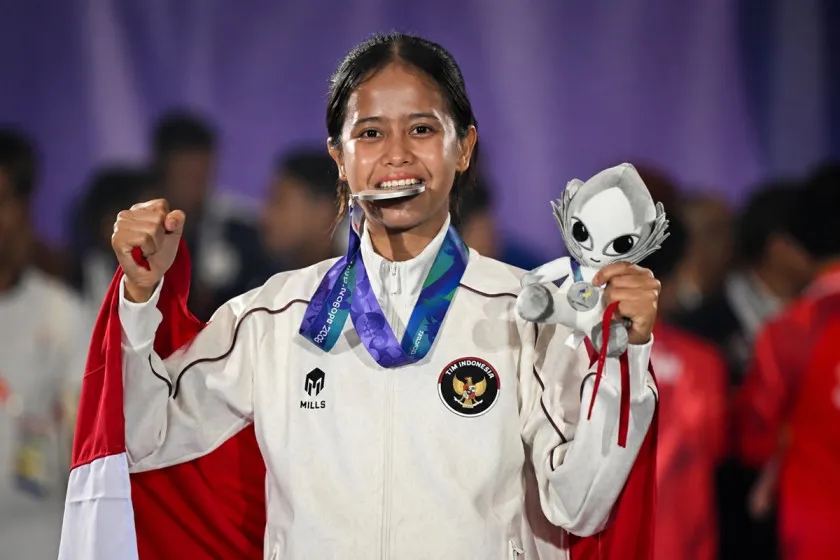
Nagoya, Japan - Gold may not have ended up in Sumaya's hands. Even so, this 21-year-old athlete has already made history by winning Indonesia a silver medal in teqball's very first appearance at the 2026 Aichi-Nagoya Asian Games.
Competing at Nagoya City Higashi Sports Center on Sunday (20/9/2026), Sumaya was ultimately outmatched by Myanmar representative Wai Khin Hnin in a tightly fought women's singles final that went the full three sets.
Sumaya took the opening set 12-10. Wai Khin Hnin then fought back to level the match with a 12-8 second set victory.
READ ALSO
Indonesia's contingent jersey for the 2026 Asian Games carries the Nusantara identity.
Eugenia Diva Wins Bronze, Indonesia Competes in 15 Sports at the 2026 Asian Games
Asian Games 2026: Indonesian Citizens in Japan are being prepared to become support volunteers for the Indonesian contingent.
In the deciding final set, Sumaya held strong early positions, first leading 4-1 then again holding a 7-6 advantage. However the Myanmar athlete turned the tide, closing out the match with a 12-9 final set win.
Gold had slipped away.
Even so, this silver remains an extraordinary achievement. This marked the first time teqball was ever contested as an official Asian Games sport, and Sumaya secured her place in the history of this discipline's continental debut.
Sumaya's Silver And Indonesia's Six Medal Total
Sumaya's medal formed part of a strong opening performance from the Indonesian contingent at the 2026 Aichi-Nagoya Asian Games.
On the first day of medal competition, Sunday 20 September, Indonesia collected one silver and four bronze medals. Sumaya claimed the silver in women's singles teqball, while the four bronzes were won across wushu, teqball and soft tennis.
This tally grew on Monday 21 September when Eugenia Diva Widodo won bronze in the women's changquan wushu event.
As of Monday morning 21 September, Indonesia held a total of six medals: one silver and five bronze.
These results kept Indonesia's Aichi-Nagoya campaign on track. Multiple athletes across different sports remained in competition, with clear opportunities to add further medals for the national contingent.
Indonesian Team Chef de Mission Todotua Pasaribu described this opening haul as a significant milestone.
"This result has surprised us for the better. The medal haul we have secured today is meaningful: one silver, four bronze."
Todotua expressed hope this performance would mark the start of consistent form from Indonesia across the full duration of the Games. He noted multiple sports were now entering quarter-final and semi-final rounds, keeping further medal opportunities open.
But behind Sumaya's success in Nagoya lies a long journey that began long before she stepped onto the Asian Games stage.
Growing Up In A Sepak Takraw Household
Sumaya originates from Pangkalan Nyirih, Bengkalis Regency, Riau.
She was raised in a family deeply rooted in sepak takraw. Both her parents were competitive sepak takraw athletes, with her mother having previously represented Indonesia at national level. All three of Sumaya's sisters also competed in the sport.
It was inevitable that sport became part of daily life from her earliest childhood.
"Right at home I was taught sports constantly ever since I was small," Sumaya recalled.
This family environment laid the entire foundation for her athletic ability.
Yet Sumaya's path to the Asian Games would not come through sepak takraw.
Overlooked For Takraw, Finding Teqball
Roughly two years prior, Sumaya failed to earn selection for the national sepak takraw squad.
An unexpected opportunity then arose when she was invited to try teqball at an exhibition event.
When she entered her very first competitive teqball match, Sumaya had been training in the sport for less than one full month.
Against all expectations, she won a medal.
This experience convinced her to commit fully to teqball. Since switching disciplines, Sumaya has followed a gruelling daily full-time training schedule.
"My whole life revolves around teqball now. Every single day: morning, noon, evening," she stated.
Indonesian women's singles teqball coach Benidiktus Budi Setyoko noted Sumaya developed at an exceptional rate. Her existing sepak takraw background proved invaluable; the ball control and technical instincts ingrained from childhood allowed her to adapt rapidly to teqball.
From Mixed Doubles To Women's Singles
When Sumaya first began competing in teqball she entered mixed doubles events, before coaches selected her to specialise in women's singles.
This transition posed no major barrier for her.
Instead, through every match she contested, Sumaya's ability continued to improve, until she earned her call up to the Asian Games squad.
Just two years after first discovering teqball, Sumaya arrived in Aichi-Nagoya as one of Indonesia's leading hopes in the sport making its historic Asian Games debut.
A Rocky Road To The Final
Sumaya's progress to the gold medal match was far from smooth.
Opening her Group B campaign, she defeated Lebanon's Dandal Kamar 12-9, 12-11.
But in her next group match, Sumaya was beaten by Wai Khin Hnin 12-10, 12-8.
She bounced back to defeat Kyrgyzstan's Aidana Otorbaeva in a three game thriller, 6-12, 12-6, 12-6.
This result left Sumaya in second place in Group B, forcing her to compete in the repechage knockout round.
There she overcame Cambodia's DY Koemyean 12-8, 12-7 to secure her spot in the semi-finals.
The hardest test was still ahead.
Comeback From Semifinal Deficit
In the semi-final, Sumaya faced India's Quimcy Joaquim Dsouza.
She dropped the first game immediately, losing 12-7.
But Sumaya did not lose her composure.
The second game remained deadlocked at 9-9 late on, before Sumaya reeled off three consecutive points to force a deciding final game.
Once again she faced an uphill battle. Sumaya fell behind 3-0 then 7-3 in the decider, before stringing together four straight points to level the score at 7-7.
After edging ahead 8-7, Sumaya maintained the pressure until she closed out the final game 12-7.
She won the match 7-12, 12-9, 12-7, booking her place in the final and guaranteeing Indonesia a medal.
"Stay calm, focus on one point at a time. Don't dwell on what already passed. We trained for this, to stay locked in on every single point," Sumaya stated after the match, as quoted by Antara News Agency.
The Historic Final
In the gold medal match, Sumaya once again faced Wai Khin Hnin, the same athlete who had beaten her during the group stage.
This rematch was far more closely fought.
Sumaya claimed the first set 12-10, before Wai Khin Hnin found her rhythm to take the second set 12-8.
In the deciding set Sumaya built early leads of 4-1 then 7-6.
But momentum swung back to the Myanmar camp, with Wai Khin Hnin eventually closing out the final set 12-9 to claim the gold medal.
Sumaya had to settle for silver.
Yet this medal carried enormous weight regardless.
She had been part of history, competing in the very first Asian Games final ever held for the sport of teqball.
Family As Her Constant Strength
Throughout every step of this journey, Sumaya's family has remained her foundation.
Pangkalan Nyirih lies far from the national training centre, but the distance never broke regular contact with her parents.
Sumaya would call home consistently, updating her family on training sessions and upcoming matches.
This unwavering support sustained the young athlete through the long months living away from home chasing her sporting dreams.
When news broke that Sumaya had secured her Asian Games medal, her parents broke down in tears. Not tears of sadness, but of quiet pride, watching their child's years of effort rewarded with a podium on the continental stage.
Athlete And University Student
Sumaya's story extends far beyond the sports arena.
Alongside her full time athletic career, she is also studying Public Administration at Indonesia Open University.
Balancing demanding training schedules, travel and competition with university coursework requires careful time management, but Sumaya remains committed to both paths.
This Asian Games silver medal is the biggest international achievement of Sumaya's career to date.
Yet she does not view the final defeat as an ending. Instead, she says the match has given her valuable experience to refine her game ahead of future tournaments.
From Pangkalan Nyirih To The Asian Stage
Sumaya's story began in a sepak takraw loving household in the small coastal settlement of Pangkalan Nyirih.
From toddlerhood she learned sport at the feet of her parents and siblings.
When the door to the sepak takraw national team closed, an entirely new sport opened an unexpected path.
In just two years after first discovering teqball, Sumaya progressed through relentless daily training, battled through the group stage, repechage and semi-finals, all the way to an Asian Games final.
She may not have brought gold home from Nagoya.
But Sumaya brought home something no less precious: a permanent place in the history of teqball's first ever Asian Games appearance.
Her journey from rural Riau to Nagoya proves that an athlete's path to the continental stage does not always run through the sport they were first raised in.
For Sumaya, this silver medal is most likely not the finish line. It may just be the first step of a long, successful career in teqball.






Belum ada komentar. Jadilah yang pertama!